AI Model Training Explained: From Data Collection to Deployment

In Artificial Intelligence (AI), model training determines the performance, accuracy, and generalization capabilities of computational systems. Efficiently trained AI models are more likely to offer accurate predictions, recognize patterns, and deliver the best results in production environments. Individuals and organizations looking for help with the AI model training process can hire our experts for help with optimizing models to make accurate decisions and predictions on new data. We handle every step of the AI model training process, from defining the clients’ objectives to deployment and integration into existing systems. This article contains the detailed procedure of AI model training that is followed by our experts.
What is AI Model Training?
AI model training involves feeding large data sets to an algorithm to enable the software system to identify patterns and perform human-like tasks. When training an AI model, experts use data that resembles real-world problems that the intelligent system might encounter, enabling the AI model to learn patterns and relationships to make accurate predictions. Types of AI models that our experts train include (i) classification, (ii) regression, (iii) generative, and (iv) foundation. Our experts also offer services such as AI agent creation, qualitative and quantitative analysis, and dashboard creation.
Classifications of AI Model Training
There are three main classifications of AI model training, which include pre-trained, fine-tuned, and fully custom-trained AI models. Trained AI models are software systems that have been initially trained on a voluminous and general-purpose dataset before being applied for specific tasks. Fine-tuned AI models are pre-trained intelligent systems that are refined using smaller and specific datasets to improve performance for specific tasks. Fully custom-trained models are specialized AI systems that are fine-tuned on proprietary data to conduct unique tasks with high accuracy and are designed to meet clients’ specific needs.
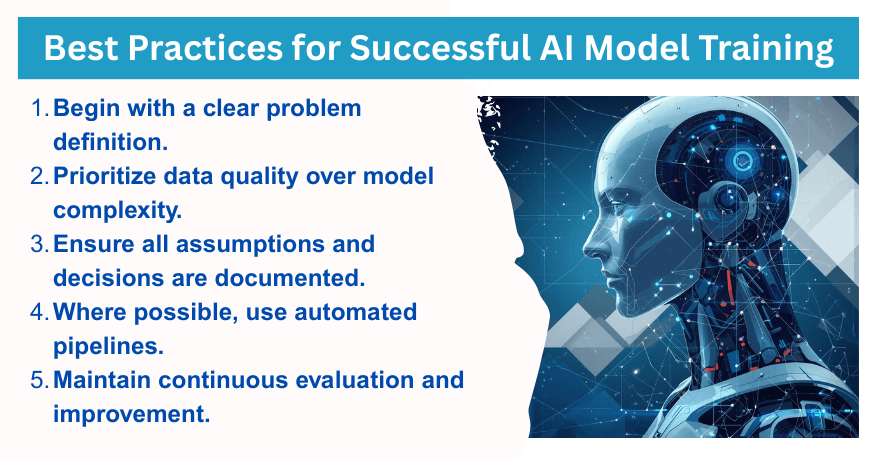
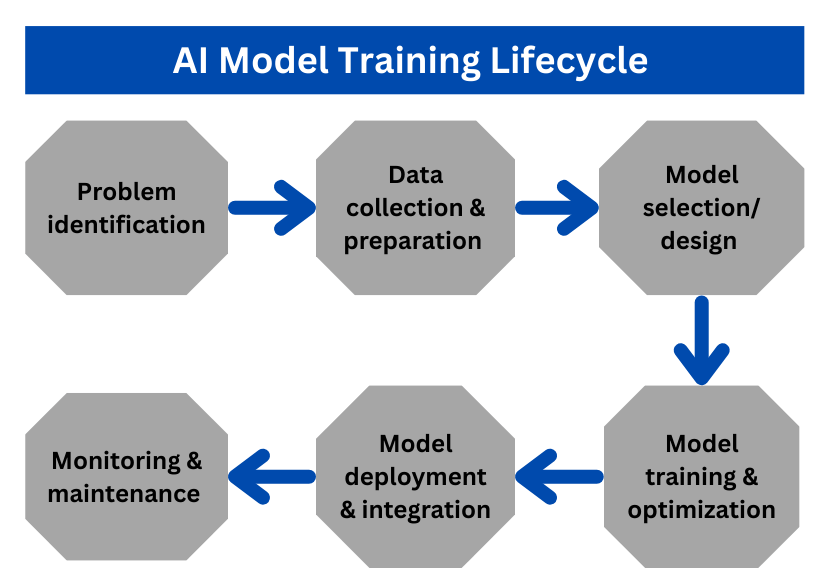
AI Model Training Process: A Comprehensive Guide by Our Experts
AI is an essential element in modern enterprise systems, enabling businesses to utilize data for automation, decision-making, and optimization of operations. However, the deployment and maintenance of AI models can be associated with challenges such as security risks and model drift. Without an effective AI model lifecycle management plan, deployed systems can degrade with time, thereby contributing to performance problems and inaccurate results.
The AI model lifecycle encompasses the entire process from development to deployment, monitoring, optimization, and retirement. Understanding the AI model lifecycle enables clients to recognize the steps followed by our experts when developing intelligent systems that deliver efficient value to operations. Drawing on over 10 years of experience, we have become the best AI model training service provider for individuals and organizations seeking accurate and secure intelligent systems. Learn how our AI model training experts help clients optimize their intelligent systems through our detailed process. Additionally, you can reach out our experts for help with dashboard creation, BI consultation, and qualitative and quantitative data analysis.
Step 1: Problem Identification and Setting Objectives
Defining the goals of the model is the foundation for the successful implementation of AI. Problem identification involves locating the issues or opportunities that the AI model can solve. Our experts identify the problems and translate them into objectives. We ensure that the AI model training process is focused and the deployments align with client goals.
Step 2: Data Collection
There are two main classifications of data that can be used in AI model training, which are structured and unstructured. Structured data is machine-readable, annotated, and has metadata that the model can learn from. Unstructured data includes no annotations or metadata and comprises only original images, text, and video.
Data collection methods we utilize include gathering data from external sources, such as social media, web scraping, and online surveys. We also utilize AI-generated data by using AI models to generate synthetic data that is similar to real-world data in cases where manual data collection is difficult. Additionally, we collect proprietary data from a company’s internal databases.
Step 3: Data Preparation
Raw data collected from multiple sources usually requires preprocessing to ensure accuracy and relevance. Training an AI model on unprepared data can cause a variety of errors, which ultimately lead to inaccuracy. Examples of data preparation techniques employed by our experts include normalizing, standardizing, dealing with missing data, and eliminating outliers, among others.
Step 4: Model Selection and Architecture Design
Model selection involves choosing the best machine learning approach based on the users’ intended task. Our skilled machine learning engineers outline the problem, select candidate models that are likely to perform well, determine evaluation metrics, and assess the models to choose the best choice. Key factors we consider when selecting AI models include the compute requirements, deadlines, cost, and complexity.
Architecture in AI refers to the structure of a model. Architecture designs demonstrate key components such as the types of layers used by the automated system, how they are connected, and how data flows through the software to make predictions. Examples of common architecture designs we use include Transformers, Feedforward Neural Networks (FNN), and Convolutional Neural Networks (CNN).
Step 5: Training and Optimization
Training entails adjusting the parameters of a machine learning algorithm until the resulting AI model’s output meets a metric of accuracy. Our experts tune hyperparameters by choosing a loss function, setting the update rate of parameters, or altering the architecture design to improve model learning. Our experts apply three main techniques, which are supervised, unsupervised, and reinforcement learning, to train AI models. We also optimize the AI model by adjusting internal parameters or weights using algorithms to aim for maximum accuracy.
Step 6: Validation and Hyperparameter Tuning
AI model validation is important for determining the performance of an intelligent system and its suitability for real-world applications. Our experts comprehensively test the AI model to identify problems and gaps in the algorithm. We utilize a different dataset from the initial training set to validate the AI model, ensuring the system is able to generalize in real-world scenarios. Key variables we evaluate for when validating the AI model include precision, percentage of accurate predictions, and correct class identification.
Hyperparameters are settings that determine how and what an AI model can learn and how well the system will perform on out-of-sample data. There are four main methods that our experts use for hyperparameter tuning, which include Bayesian optimization, hyperband, randomized search, and grid search. We conduct hyperparameter tuning to minimize the loss function of a machine learning model, enabling accuracy.
Step 7: Evaluation and Testing
Evaluation and testing help in ensuring that the AI model is accurate and can deliver significant value in production environments. Accuracy is one of the common metrics our experts evaluate for in AI models. However, accuracy is not the most appropriate metric for certain tasks, especially in cases of imbalanced data. Other metrics we evaluate for include accuracy, precision, F1 score, recall, and AUC-ROC (Area Under the Receiver Operating Characteristic Curve), depending on the problem of the AI model. We also test the AI model by identifying biases and systematic errors that might lead to inaccurate outcomes.
Step 8: Deployment and Integration
AI model deployment involves integrating a machine learning system into an existing production environment where it can receive an input and generate an output. Deployment aims to make the predictions from a trained machine learning model available to users, management, and other software applications. Our experts follow a systematic process when deploying AI models, which encompasses planning, setup, packaging, and deployment. Methods of AI model deployment we employ include real-time, batch, streaming, and edge techniques.
We also integrate AI models into existing frameworks, allowing the system to learn from patterns in clients’ data, enabling task automation and trend prediction. Looking for expert assistance with training AI models? Enlist our professional services today from the best machine learning engineers in the market. We handle every step of the AI model training process, enabling clients to focus on optimizing their operations.
Why Hire AI Model Training Experts From Our Company?
Key reasons why clients choose us for machine learning model training include:
- Team of experts in AI. Our highly skilled professionals offer the best machine learning and AI model training services to clients, enabling them to improve their operations.
- Proficiency in multiple fields of study. We provide industry-specific AI model training across multiple fields, including healthcare, retail, e-commerce, manufacturing, logistics, and hospitality, among others.
- Use of the best AI model training tools. We utilize advanced tools and frameworks such as TensorFlow, PyTorch, Scikit-Learn, and Hugging Face Transformers to optimize machine learning workflows and get accurate AI models that deliver the best results.
- Client-focused approach. Our experts ensure maximum client satisfaction by continuously refining AI models based on client feedback to ensure relevance and effectiveness.
- Round-the-clock availability. Our consultants are available 24/7 to offer personalized assistance to clients without having to wait for standard working hours. Clients can reach out to us at any time to inquire about our services, get regular order updates, maintenance, and optimization.
Summary
AI model training involves exposing a model to a volume of data and training the algorithms to analyze patterns and make decisions or predictions based on new information. Various types of AI models can be trained, including classification, regression, generative, and foundation. In case you are searching for experts who offer professional AI model training services, look no further. With 10 years of experience in AI, we help clients optimize their models that deliver the best results in various industries. Ready to get started? Hire our AI model training experts today and get effective intelligent systems tailored to your specific needs. Contact us or talk to our friendly customer service agents for any inquiries on AI model training.