Use Cases of AI Agents in Business Process Automation
The ability of AI agents to reason, plan, and act enables intelligent systems to conduct advanced data analysis and make decisions that would be impractical to automate with predefined rules and logic. Backed by advanced models such as Large Language Models (LLMs) and deep learning, AI agents can decide a course of action and employ various software tools to execute tasks without human intervention. Are you a business owner seeking professional help with developing AI agents for business automation? Partner with us to design, build, and deploy solutions that deliver real results.
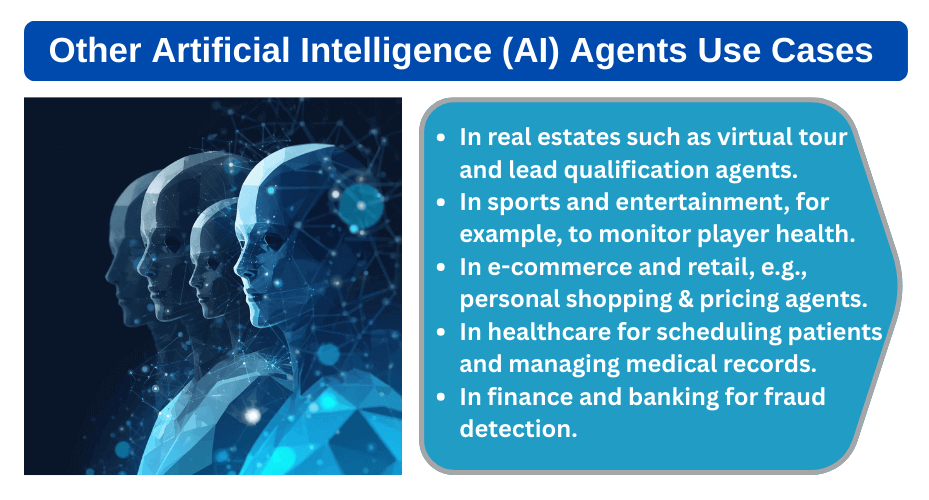
Our experts specialize in advancing clients’ business operations by creating AI agents that automate repetitive tasks, enhance decision-making with data-driven insights, improve customer engagement, and streamline workflows. We design robust and custom AI agents for industry-specific use cases, including banking, finance, healthcare, real estate, and business, among others. This article highlights common AI automation use cases in business operations, such as customer support, product development and innovation, and fraud detection.
What is an AI Agent?
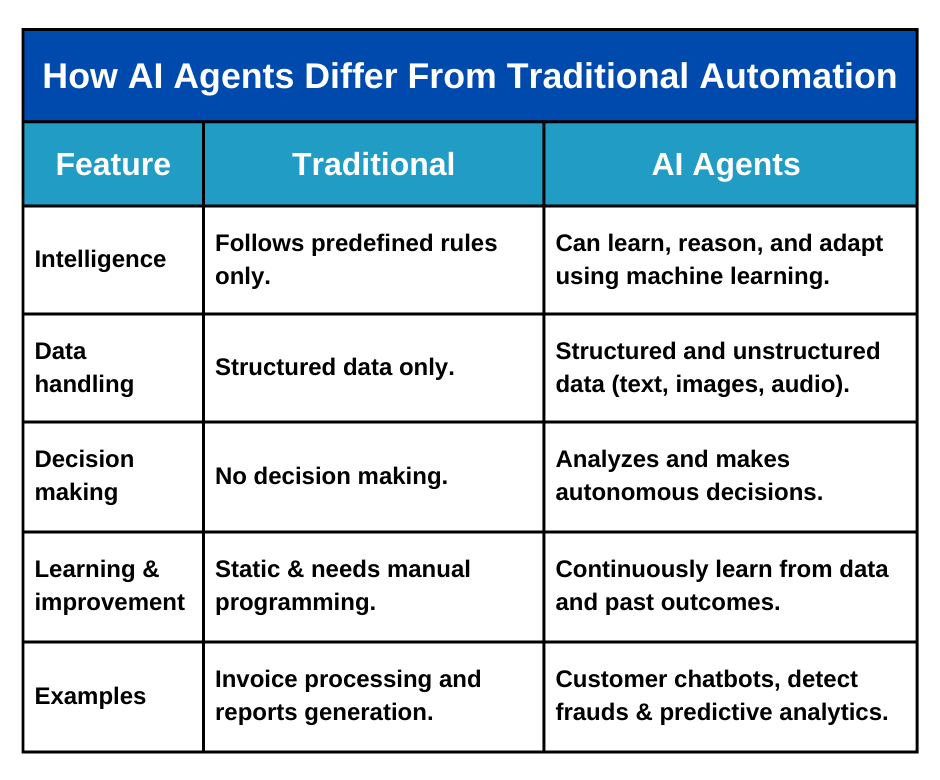
An AI agent is a software system that is capable of autonomously performing tasks on behalf of a user. In business contexts, AI agents leverage advanced technologies such as machine learning, natural language processing, and LLMs to simplify routine tasks, optimize workflows, and enable smarter decision-making. There are various types of AI agents, each designed to handle specific tasks with distinct levels of complexity. Our experts develop five main types of AI agents, based on client objectives, which include:
- Simple-reflex agents.
- Model-based reflex agents.
- Goal-based agents.
- Utility-based agents.
- Learning agents.
AI Automation Use Cases in Business Operations
Business process automation has become a fundamental strategy for improving operational efficiency and driving growth within modern enterprises. Automation in business operations involves using technologies to streamline repetitive tasks, traditionally performed by humans, including customer assistance, transaction processing, and data entry, among others. By automating routine tasks, businesses can improve speed and accuracy, allowing stakeholders to focus on other essential tasks such as innovation, decision-making, and problem-solving.
The integration of AI into business operations has revolutionized the way in which companies operate. By deploying AI agents into organizations, clients can optimize processes across multiple business functions such as supply chain management, human resources, finance, and customer service. At our company, we specialize in developing custom AI agents, based on clients’ objectives that are capable of handling complex business procedures. We guarantee effective AI agent performance through adequate training, proactive monitoring, and continuous optimization. Some AI automation use cases that can be applied in business operations include:
1. Product Development and Innovation
AI enables product development and innovation by automating processes from market research to launch and iteration, allowing businesses to introduce new products into the market faster. First, AI tools utilize Generative AI systems to sift through complex business data sets to gain insights into user behavior. Machine learning algorithms are then used to identify challenges and consumer preferences that can offer new opportunities for product development. The second step is ideation, where AI-powered text and image generators help business owners build mockups of potential products that can be reviewed by stakeholders for market fit.
Third is the design and prototyping phase, where business owners apply AI tools to transform a concept of a new product into a prototype faster than organizations would manually. Fourth, AI-driven tools are used to build and validate the product with metrics such as performance, user experience, and sustainability. Our experts help clients integrate AI tools in product development, enabling business owners to increase sustainability, make informed decisions, enhance workflow automation, and achieve higher product quality
2. Supply Chain and Inventory Management
Supply chain and inventory management is the practice of overseeing a company’s stock levels to ensure that products are in the right place when needed. AI tools improve supply chain and inventory management through the application of machine learning, data analysis, and predictive analytics. Some use cases of AI in supply chain and inventory management include i). demand forecasting, ii). anomaly detection, iii). supplier management, iv). real-time visibility, and v). warehouse operations. Our experts help employ AI in supply chain and inventory management, providing benefits such as enhanced accuracy, cost savings, and scalability.
3. Human Resources
AI in human resources encompasses combining algorithms, machine learning models, and intelligent systems to streamline recruiting, automate onboarding, tailor talent management, and enhance employee experience. Common AI technologies utilized in human resources include AI agents, assistants, Gen AI, natural language processing, and data analytics. Our experts offer custom solutions, including developing robust AI agents that can be used to source candidates, scan job boards, and professional networks to identify potential candidates.
4. Customer Support
AI-powered systems make customer service faster, more personalized, and efficient, increasing consumer satisfaction. AI virtual assistants, intelligent chatbots, and agents utilize natural language processing and machine learning algorithms to automate tasks such as addressing user inquiries, offering personalized recommendations, and providing support for technical issues. AI also enables support ticket automation by identifying keywords and understanding customer sentiment to route and sort tickets based on urgency. Our skilled AI agent developers prioritize human-centric designs that deliver realistic and intuitive interactions while easing the load on human customer-service teams.
5. Data Analysis and Decision Support
AI data analysis involves employing advanced techniques such as machine learning algorithms and natural language processing to collect, analyze, and interpret business data to discover patterns, trends, and gain useful insights. AI also supports decision-making by automating repetitive tasks, conducting market research, automating human resources data-driven decisions. By leveraging AI in data analysis, business owners can unlock powerful insights, make better decisions, optimize operations, and maintain a competitive edge. Other AI automation use cases in business include market and process, financial planning, fraud detection, and lead management. In case you are looking for professional business AI solutions, look no further, as we specialize in building intelligent systems tailored to clients’ specific objectives. Get in touch with our experts today to discover how we can help you implement AI into your business operations, whether through quantitative analysis, AI agent development, or AI workflow automation.
Benefits of Using AI Agents for Business Automation
Integrating AI workflow agents into business operations can positively transform how organizations operate, compete, and grow. At our firm, we specialize in creating custom AI agent solutions designed to deliver practical business value. By hiring our experts for help with AI agent development, business owners get:
- Improved operational efficiency. AI agents enable operational efficiency in business by automating repetitive tasks, analyzing large datasets to identify patterns and predict trends, optimizing complex processes, and providing accurate insights that enable better decision-making.
- Reduced costs. By automating some manual tasks such as data entry and answering customer service inquiries, businesses eliminate reliance on manual labor, thus enabling organizations to reduce payroll expenses and allocate budgets to other initiatives.
- Personalized consumer recommendations. AI agents integrate machine learning data to identify patterns, trends, and insights on consumer behavior. By analyzing and interpreting user algorithms, natural language processing, and Gen AI technologies to collect and analyze customer behavior, AI agents recommend products and services based on the consumer’s preferences and demographics, thus improving customer satisfaction and loyalty.
- Enhanced decision-making. AI agents rapidly analyze large datasets, identify patterns, predict outcomes, and deliver accurate insights that enable better business choices.
Summary
AI is transforming business operations by offering advanced technologies that enhance operational efficiency, decision-making, customer experience, and enable scalability. Companies that employ proactive steps to adopt AI agents in their operations are more likely to gain a competitive advantage in their industry. If you would like to hire experts for assistance with developing AI agents for business automation, contact us to discover how we can help create scalable and efficient intelligent systems, tailored to your unique needs.