Custom AI Model Training Services

To perform effectively, artificial intelligence (AI) models require the application of strategic and continuous training techniques. With AI model training, developers can create a mathematical model that produces accurate output while handling possible variables, outliers, and data complexities. In case you are looking for professional AI model training services, we are your ideal choice. Our cross-functional team, comprising expert data scientists and engineers, provides the best solutions to help clients optimize their AI-driven projects and increase accuracy, efficacy, and scalability.
By hiring our professionals for AI model training, clients gain access to the best services tailored to their unique challenges and goals. We also offer data analytics services, quantitative and qualitative analysis, BI consultation, and market research, among others. We deliver well-trained and fine-tuned AI models that effectively yield measurable returns. In this article, we have discussed the step-by-step process our experts follow when training an AI model from problem definition to governance and ethics.
What is AI Model Training?
AI model training is the practice of teaching an artificial intelligence model to analyze structured data and detect patterns without human intervention. The process of AI model training involves feeding data into algorithms, adjusting model parameters, and optimizing performance through techniques such as supervised, unsupervised, and reinforcement learning. In the era of artificial intelligence, the ability to train powerful and accurate models is essential for unlocking the true potential of AI applications.
If you are looking to hire experts to train AI model, we have the best developers and data engineers who are highly skilled and have the theoretical knowledge to handle any AI-related project regardless of the complexity. Contact us today to get started with services such as AI agent creation, AI model training, and data analytics, among others.
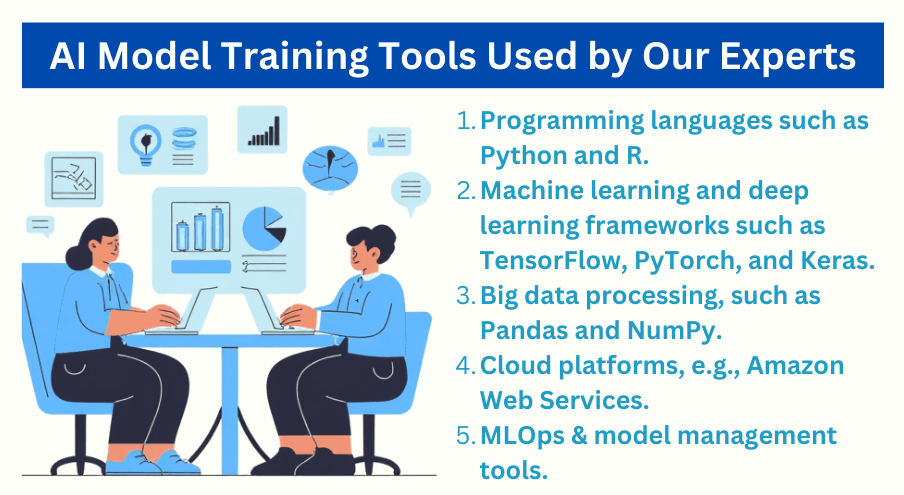
How to Train an AI Model: A Step-by-Step Guide by Our Experts
Below is a detailed breakdown of the procedure followed by our experts when AI model training:
Step 1: Problem Definition and Objective Setting
Before commencing the AI model training process, it is important to define the problem to be solved and set specific and measurable objectives. By understanding the problem, our experts ensure that the AI model’s capabilities align with the client’s outcome, whether it is identifying fraud, predicting trends, optimizing a process, or classifying media. Defining a clear problem determines the AI model training process by dictating the data to be collected. Setting clear goals also helps determine the metrics by which the success of the AI model will be evaluated, such as accuracy or precision. A narrowly defined use case and requirements analysis also keeps the scope in check.
Step 2: Data Collection and Understanding
AI models often require large volumes of high-quality data for training. Our experts utilize three main types of data sources for training AI models, including i). licensed data, ii) publicly available data, and iii). data covered by public copyright licenses. Common methods we employ to collect data efficiently for AI model training include web scraping, Application Programming Interfaces (APIs), manual collection, and crowd sourcing, among others.
Step 3: Data Preparation
Raw data requires significant cleaning and preparation to ensure that it is usable and yields accurate results. Our experts prepare data for AI model training by eliminating duplicates, handling missing values, standardizing formatting, normalizing values, and addressing inconsistencies within the dataset. We also verify the data integrity and consistency, ensuring that it is capable of supporting reliable outcomes.
For supervised learning AI models, data must be labeled and annotated with significant detail. Preparing data is one of the most time-consuming but important steps in the AI model training process. Our AI model training experts can handle this critical step, ensuring clients’ data is ready for accurate model training.
Step 4: Model Selection and Architecture Design
Variables to consider for model selection include the size and structure of the dataset, computational resources available, and the complexity of the defined problem. Common AI training models our experts utilize based on client requirements include i). linear regression, ii). logistic regression, iii). decision trees, iv). random forests, v). neural networks, and vi). Support Vector Machines (SVMs). Our experts also design the AI model architecture, ensuring that it captures the patterns in data. We optimize layers, parameters, and structures to achieve high accuracy and reliable performance based on the clients’ use case.
Step 5: Training and Optimization
Selecting the right training technique involves considering key factors such as available resources, costs, complexity, and computing requirements to optimize the performance of the AI model. Techniques that can be employed in AI model training include i). supervised, ii). unsupervised, and iii). semi-supervised learning. Our experts train and optimize the AI model by inputting the prepared data into the AI model to identify errors and make adjustments to increase accuracy. We evaluate the AI model for overfitting and underfitting, which may undermine an accurate interpretation of new data.
Step 6: Validation and Hyperparameter Tuning
Validating the performance of the AI model involves assessing how it performs on a different data set not utilized during the training process. By validating the AI model, our experts determine if the model requires additional training or modification. We also perform hyperparameter tuning, which involves identifying and selecting the best settings for use in training an AI model to optimize its performance, accuracy, and ability to generalize. Hyperparameter tuning is a crucial aspect in AI model training, as parameters such as learning rate control the model’s behavior and performance.
Step 7: Evaluation and Testing
Once the AI model has been validated, it is evaluated for its performance using testing data sets. Our team of experts utilizes various metrics to assess performance, including recall, F1-score, accuracy, and precision. By assessing model performance, we determine whether the AI model is underfitting, overfitting, or has achieved the set objectives.
Step 8: Deployment and Integration
Deployment is the process of making a trained AI model in a real-world environment where it can receive data and return feedback. Integration involves embedding AI models into existing systems, pipelines, and user applications to automate tasks and deliver real value. When the AI model is accurate and meets required expectations, our experts deploy the models via APIs, in cloud environments, or directly into applications.
Step 9: Monitoring, Maintenance, and Retraining
As more data is collected and AI models are exposed to new variables, models can become outdated and less effective if not properly maintained. This is why monitoring, maintenance, and retraining are important to avoid failure in performance and accuracy. Some of the techniques we employ to ensure continuous, accurate, and reliable results include model retraining, performance monitoring, troubleshooting, and data updates. Get in touch with our experts for AI model training services, dashboard creation, data analytics, as well as qualitative and quantitative data analysis.
Step 10: Governance and Ethics
Governance and ethics involve integrating principles such as privacy, accountability, and transparency throughout the AI model’s lifecycle to ensure compliance with laws, build trust, and prevent harm. When training AI models, our experts ensure compliance with governance and ethics by applying ethical data sourcing, following laws such as the General Data Protection Regulation (GDPR), and utilizing robust governance frameworks. Are you an individual or business owner looking to build a reliable and high-performance AI model? We help clients develop and train AI models that deliver measurable outcomes. Reach out to us today for any inquiries.
Get Professional AI Model Training Services From the Best Experts
Deloitte predicts that 50% of enterprises will utilize autonomous AI agents by 2027. Thereby, if individuals and organizations want to stay relevant, they need to train AI agents to make accurate predictions and decisions without explicit programming. With effective AI model training, individuals are assured of improved decision-making, boosted efficiency, and an enhanced user experience.
However, if done wrong, AI model training can drain budgets and slow down innovation. This is why most tend to enlist the services of domain experts to get AI models that are accurate, perform efficiently, and deliver effective outcomes. At our company, we have the best professionals with skills and experience in handling various AI-related projects regardless of the scope and complexity. Some of the AI model training services we offer include:
- AI consulting.
- Custom AI model training.
- Data preparation and feature engineering.
- Model selection and design.
- Fine-tuning and optimizing pre-trained AI models.
- Model deployment and monitoring.
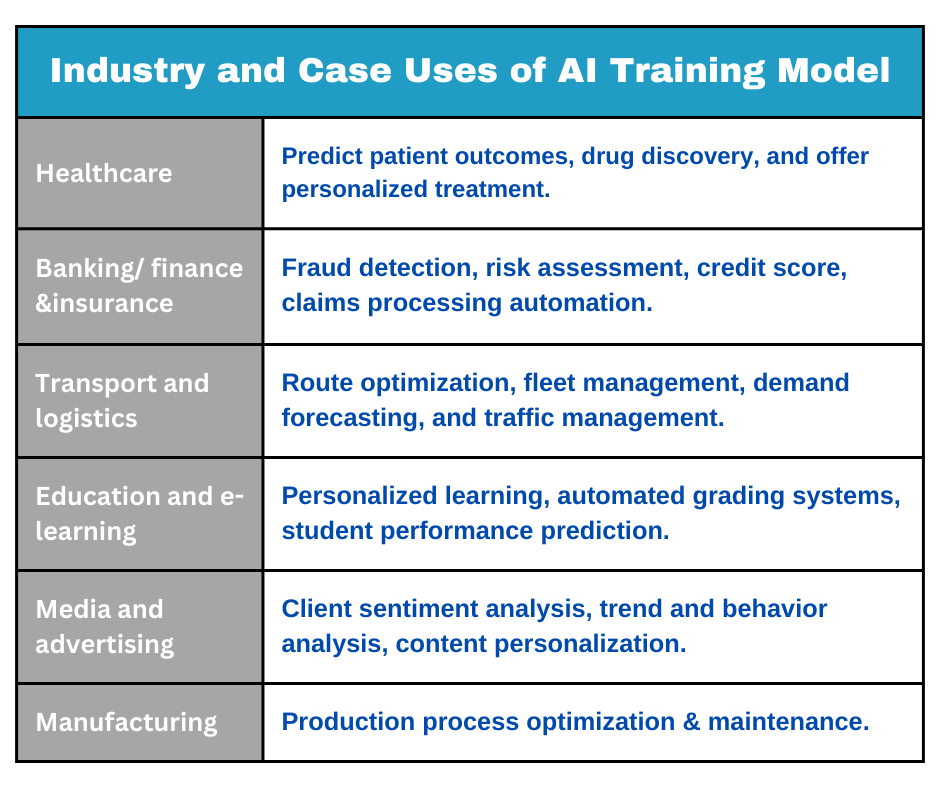
Why Hire Experts to Train AI Model From Our Firm?
AI model training is a repetitive process whose success depends on the quality of the data and the ability of the trainers to ensure the automated systems learn accurately and without bias. By hiring skilled AI trainers, individuals and organizations ensure better accuracy, performance, reduction of errors, and alignment with objectives. Key reasons why we are the ideal solution for clients’ AI model training needs include:
- Highly skilled AI specialists. Our team comprises professional data analytics experts, data scientists, AI engineers, and domain experts who are well-versed in AI model training and deliver accurate models.
- Measurable Return on Investment (ROI). When clients hire experts to train AI model from our firm, they receive a direct ROI in the form of cost reduction, revenue generation, improved decision-making, or risk mitigation, depending on client needs.
- Expertise across multiple industries. Our experts are skilled and have 10+ years of experience in delivering excellent solutions for sectors such as healthcare, finance and banking, retail, market research, construction, robotics, and manufacturing, among others.
- Custom AI model training services based on client needs. Our experts train clients’ AI models specifically for their use case, industry, and objectives. We adopt tailored AI model training and develop models in various languages if required for each specific case.
- Excellent customer support. At our firm, we have flexible communication channels, schedules, continuous client support, and timely assistance to ensure the best cooperation between both parties.
Table of Contents
Summary
AI model training is the practice of teaching algorithms to identify patterns, relationships, and insights from data. During training, AI models learn by adjusting internal parameters based on historical data, thereby making predictions and decisions on new data. Effective model training requires skills and the utilization of high-quality datasets, feature engineering, algorithm selection, and continuous optimization. Therefore, most individuals and organizations prefer to hire experts to train AI model to ensure accuracy, reduce bias, and align their algorithms with their aims and objectives. Ready to improve your AI model performance? We would like to hear from you. Schedule a consultation today to discover how we can help by contacting us. We are available 24/7 to serve you promptly.